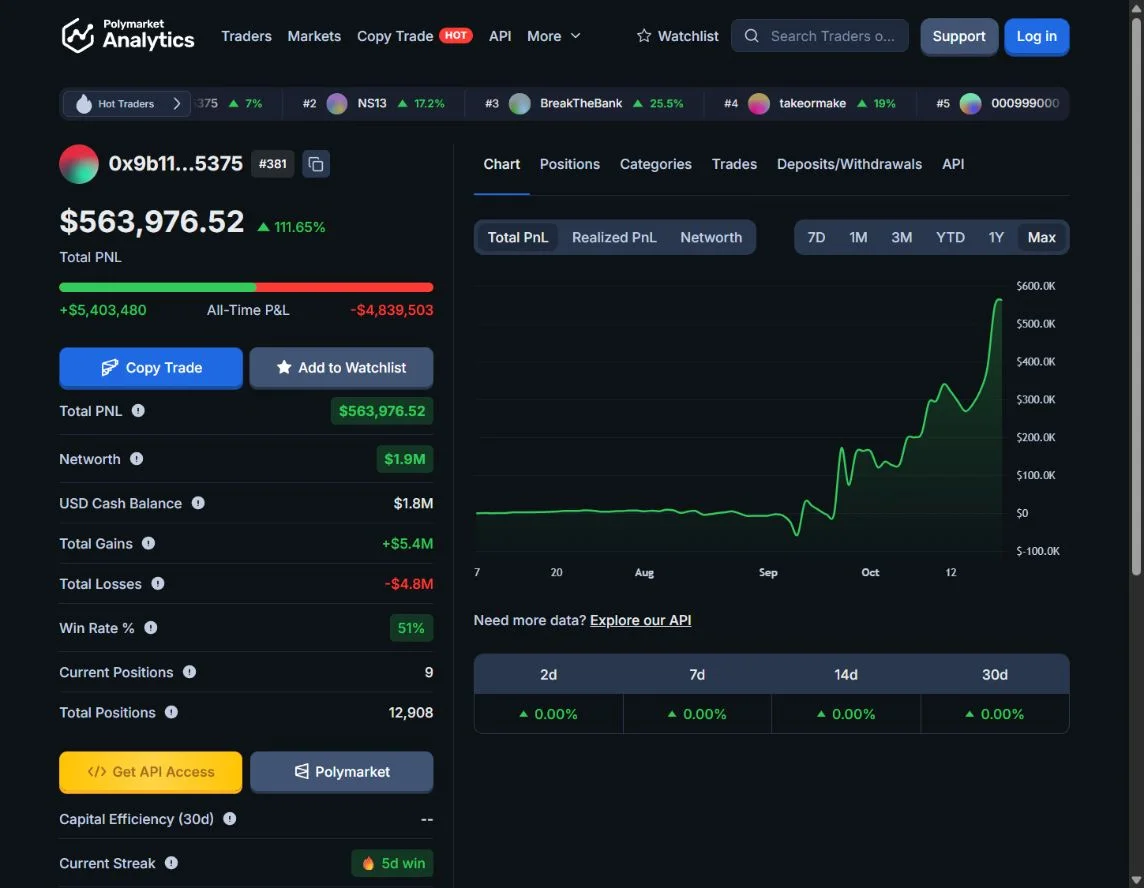
A Polymarket leaderboard can help you discover a wallet worth investigating. It cannot, on its own, tell you that the account has a repeatable edge, used little capital, avoided large drawdowns or can be copied at the same price.
The useful workflow is to move from a ranked number to an account history, then to the decisions and exposure behind that history. Start with the first-party public analytics or a tool such as Polymarket Analytics. Keep the exact address and observation date throughout the review.
Record the metric and the window
Before comparing two accounts, write down the leaderboard's time period and ordering. Is the board sorted by PnL or volume? Is the figure daily, weekly or lifetime? Does the tool describe the units?
The current Polymarket Data API documentation distinguishes monetary PnL from share-based volume in its analytics examples. Other providers can define volume differently. Two columns with similar names are not necessarily comparable measures.
Use the same window for the candidate wallets. A lifetime total beside a weekly result is not a fair comparison. Preserve unavailable data as unavailable; a missing number should not become a zero-return account.
Separate realized and unrealized results
Realized PnL concerns value crystallized through the relevant accounting events. Unrealized PnL concerns open exposure valued using the source's marks. Inspect the provider's definitions rather than assuming every platform treats settlement, redemptions, transfers and fees identically.
Here is a hypothetical comparison. Wallet A shows $900 realized profit and $2,100 of open-position gains. Wallet B shows $1,200 realized profit and a $100 open loss. A combined headline would favor A, while a realized-only comparison would favor B. Neither tells you the capital at risk or whether the marks are executable.
That example is arithmetic, not a claim about any featured wallet. Use a market order book to understand why a last-traded mark may differ from the price available for a large exit.
Account value is not a return calculation
Keep deposits and withdrawals separate from trading performance. A wallet that grows after a large deposit has not necessarily earned that growth. A wallet with repeated withdrawals may have a small current balance despite a long trading history.
Without a reliable capital and cash-flow history, do not label profit divided by today's account value as lifetime ROI. Also avoid comparing absolute profits as if both wallets operated at the same size.
The public Polymarket Analytics profile has separate chart and cash-flow views. The platform walkthrough explains which controls to inspect.
Check concentration and the shape of the history
Find out whether one resolved event produced most of the result. A wallet can have many positions but remain concentrated in one election, sports competition or correlated outcome family.
Look at the time path rather than only the ending total. Were there long drawdowns, abrupt jumps or a recent strategy change? Did the trader remain active after the conditions that produced earlier gains changed?
A high win rate also needs context. Frequent small wins can coexist with occasional large losses. Ask how much was lost when the account was wrong, not only how often it was right.
Look for category-specific experience
Separate politics, sports, weather and short-duration crypto activity where the tools allow it. A strong record in one field does not establish skill in every market.
Scores can help prioritize a closer look, but treat them as a provider's model of historical behavior. The Hashdive and Unusual Predictions guide explains how to use those screens without turning a score into a guarantee.
Ask whether the behavior is observable and copyable
A public wallet may be one part of a larger strategy, including other wallets or positions elsewhere. Sales are also not the only way an on-chain position can change: splits, merges, redemptions and transfers can matter.
Even a correctly observed trade may arrive too late to replicate. The target's size, entry price, available liquidity and fee environment may differ from yours. Before authorizing any service, use the copyability checklist.
Finish with a research note
Record the wallet, metric, period, data source, realized/open distinction, cash-flow limitations, category concentration and one reason to reject the candidate. Leave unresolved accounting questions explicit.
For repeatable public reads, continue to the Data API v2 wallet guide. For inspecting the actual query behind a chart, use the Dune guide. The goal is a better-supported investigation, not a list of wallets promised to make money.